The real cost of ignoring stress at work (and what Melbourne companies are doing about it)
Workplace stress costs Australian businesses $14.81 billion a year. Here's what Melbourne companies are doing about it - and why many responses don't work.

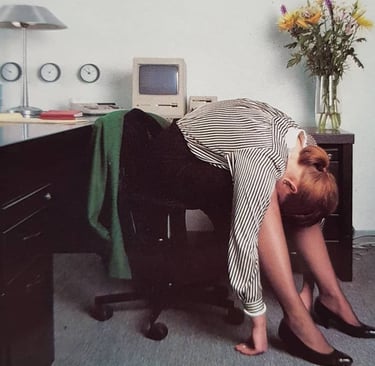
Workplace stress costs Australian businesses approximately $14.81 billion annually. Not in some abstract economic sense - in real costs! This looks like people not coming to work, people showing up but not functioning or contributing, people leaving early or leaving altogether, people making claims.
That number has been climbing for years. And in 2025, it accelerated full speed.
New data from Allianz Australia shows a 17.3% increase in primary psychological workers' compensation claims last year, with over 40% linked to mental stress and work pressure. This is huge! The cost of a psychological injury claim is 2.7 times that of a physical one. Which means the invisible toll is, financially speaking, the more expensive one.
Sixty-one percent of Australian workers report experiencing burnout - well above the global average of 48%. And the numbers from ELMO's Q3 2025 Employee Sentiment Index are harder to ignore: 40% of Australian employees are experiencing burnout right now. Approximately 4.3 million people. And despite more people taking leave, the rate hasn't moved. Because burnout isn't caused by needing a little break after they hit their breaking point, it's generally caused by chronic workplace conditions that persist when people come back.
Why most stress responses don't work
The standard corporate response to workplace stress is to offer an EAP. And EAPs do serve a wonderful purpose - for people in crisis who choose to reach out. Having used an EAP myself, I did find them useful in that point of no return stage of my burnout. But even if we all became burnt out and utilised the EAP, the problem persists that only about 5% of employees actually access them, according to Q3 2025 data. Which means 36% of Australian organisations do nothing to address burnout, and of those that try, more than half don't even encourage conversations about it.
That gap - between the substantial scale of the problem and the adequacy of the response - is where most workplace stress programs fail. They exist on paper but they don't land in rooms they’re meant to be in.
A stress management workshop is different because it's an active, in-person intervention. It creates a moment where people stop, sit in a room together, and learn something practical about how their nervous system works, what's driving their stress, and what they can actually do about it. It's not a webinar with a chat function - although I understand for remote, this is a great bridge to ‘get them in the room’. It's a session run by someone who knows the material and knows people.
What a stress management session actually covers
The best stress management workshops don't just teach breathing techniques and call it done, although there is absolutely a space for that in Evo Workshops. These sessions address the full picture: the physiological basis of stress, the workplace conditions that create chronic pressure, and the personal strategies that help people regulate. Participants leave with a framework they can actually use - not a pamphlet they'll forget in the bottom of a bag. We suggest pairing the session with WorkSafe Victoria's Prevention Plan for Psychological Hazards.
They also create something less tangible but equally important: a shared experience. When a team goes through a session together, they develop a common language around how they're feeling. That normalises the conversation. And that normalisation is what makes it possible for people to speak up earlier - before they're in crisis.
Okay.. but I'm in Melbourne. Does that change anything?
Melbourne businesses are currently navigating a specific regulatory moment. Victoria's new Psychological Health Regulations, which came into force in December 2025, place a legal obligation on employers to identify and actively manage psychosocial hazards - including work pressure and excessive workload. That means proactive intervention is no longer optional. It's a compliance requirement.
A stress management workshop won't tick every legal box. But it is a tangible, documented step that demonstrates your organisation is taking the issue seriously - which WorkSafe Victoria has indicated is exactly what they'll be looking for.
More importantly, it works. Not as a one-time bandaid fix but as part of a broader, holistic culture shift that tells your people "we see what this is costing you". AND we're doing something about it. AND we want you to be okay in every pillar of your life.
Evo Workshops delivers stress management sessions across Melbourne workplaces - designed for real people, in real rooms, with specialists who understand the difference between a session that lands and a session that doesn't. We handle the delivery end-to-end. You just bring the team.
Sources: ELMO Employee Sentiment Index Q3 2025; Allianz Australia mental health data 2025; Foremind Employee Burnout Statistics Australia 2025; IMARC Australia Corporate Wellness Market 2024
Contact us
Evo Workshops acknowledges and pays our respects to the traditional custodians and First People of the land on which we live, learn and grow - the Wurundjeri People. We acknowledge our events are on stolen land. We pay our respects to them and their cultures, and to elders past, present and future as well as their continuing connection to land, waters and community.
hello@evoworkshops.com.au